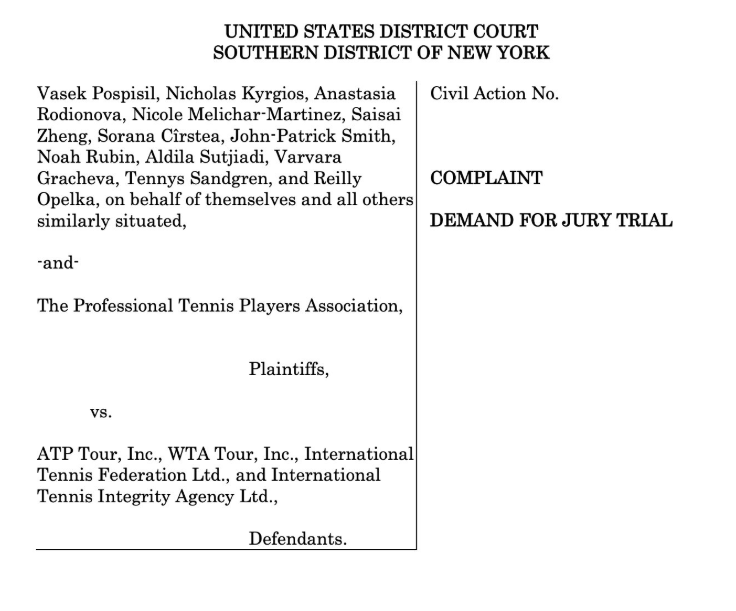
The Professional Tennis Players’ Association (PTPA) and 12 players have launched a class action lawsuit at the United States District Court in New York against tennis governing bodies including the Association of Tennis Professionals (ATP), the Women’s Tennis Association (WTA), the International Tennis Federation (ITF), and the International Tennis Integrity Agency (ITIA) for alleged “anti-competitive practices and a blatant disregard for player welfare.” The organizations denied the accusations.
Seeking a trial by jury, the 163-page lawsuit accused the governing bodies of operating a “cartel” with monopolistic practices to control image rights, ranking systems, payments and scheduling. The players seek compensation from the governing bodies and an end to their “monopolistic control” of the world tennis tours for men and women. The PTPA said it also initiated legal proceedings in the European Union and the United Kingdom.
“Professional tennis players are stuck in a rigged game” which gives them limited control over their own careers and brands,said the lawsuit, signed by former Wimbledon finalist Nick Kyrgios and former Wimbledon doubles champion Vasek Pospisil, among others.
The PTPA, co-founded in 2020 by Pospisil and Novak Djokovic, says it is acting “on behalf of the entire player population”. Pospisil and Kyrgios claimed that more than 300 pro tennis players, including top players, expressed support for the class action suit. “The ATP/WTA has spread so much fear over the years that it’s not easy to put your name on this [lawsuit] publicly,” wrote Pospisil on X, formerly Twitter.

“The time has come to demand accountability from these organizations and their complicit partners for decades of illegal practices, systemic player abuse, and exploitation that have tarnished our sport,” wrote Pospisil. “For too long, players have been forced to accept a broken system that ignores our well-being, undervalues our contributions, and leaves us without real representation. The lawsuits expose a deeply entrenched, anticompetitive system rife with monopolistic control, conflicts of interest, economic exploitation, and blatant disregard for player welfare by the defendants. These legal actions are a fight for today’s players, future generations, fans, and the future of our sport.”
The BBC quoted Pospisil as saying: “I’m one of the more fortunate players and I’ve still had to sleep in my car when traveling to matches early on in my career. Imagine an NFL player being told that he had to sleep in his car at an away game. It’s absurd and would never happen. No other major sport treats its athletes this way.”
“Tennis is broken,” tweeted PTPA executive director Ahmad Nassar. “The way tennis currently operates is both illegal and hurts everyone – players, fans, commercial partners, and even tournament owners alike. We spent several years trying to engage and reform tennis from within. To no avail. Today’s actions will spark meaningful, lasting change and accountability.” He accused the governing bodies of schedule abuse, data misappropriation and betting collusion, prize money manipulation, player exploitation & hostile work environment, abuse of power, health & safety malpractice, massive conflicts of interest, investigative abuses and privacy rights violations.
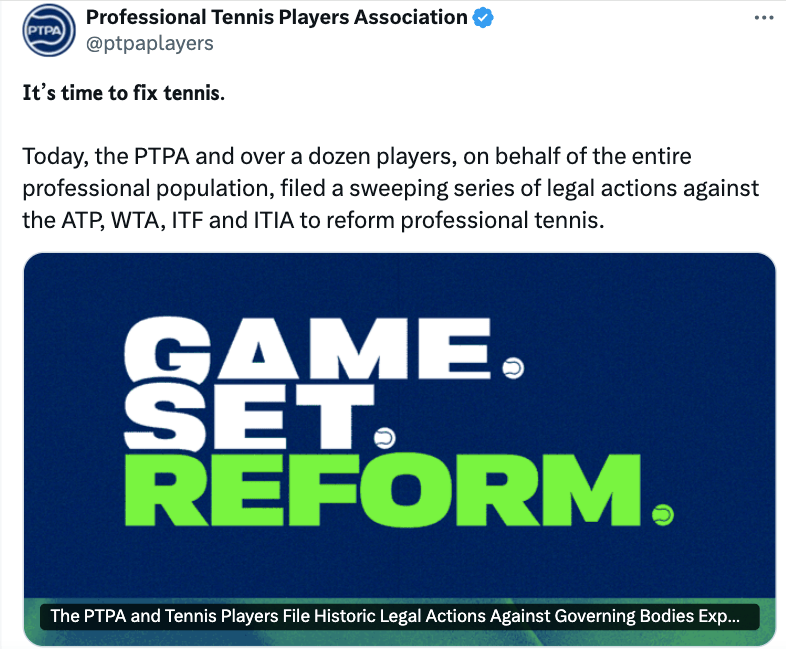
“It is time for free-market forces to enter professional tennis,” said the PTPA’s lawyer Drew Tulumello of Weil, Gotshal & Manges.
The lawsuit claims that the governing bodies act as a “cartel” by forming agreements with tournaments that cap prize money and keep out potential competitors. The PTPA called the ranking points system “draconian” because it effectively forces players to enter their tournaments in order to build a status and reputation as a professional. The lawsuit said the schedule is “unsustainable” because it runs for 11 months each year and requires players to compete in excessive heat or start matches after midnight, unlike any other sport. The lawsuit also blamed governing bodies for changing ball types which can cause serious wrist, elbow and shoulder injuries. They also claim that the governing bodies take too much of the money available to players for usage of their brands and images.
The PTPA also accused the ITIA of a “gross invasion of privacy” for searching the phones of players under suspicion of corruption or doping offences.
The ITIA, which oversees doping control in tennis, said it is proud of its “role in contributing to a clean and fair sport.”
The ITF, which oversees the four grand slams (Wimbledon, the French Open, the US Open and the Australian Open), said it was considering its response as the “global guardian of the game”.
The WTA, which offers 51 tournaments across 26 countries, said it paid out record prize money of $221 million last year and offered paid maternity leave this year for the first time. “Contesting this baseless legal case will divert time, attention, and resources from our core mission to the detriment of our players and the sport as a whole,” the WTA stated.
In a statement on their website, the ATP lauded their efforts since 1990. “The introduction of a prize money formula, record-setting on-site prize money, and new and expanded Bonus Pools have contributed to a major increase in player compensation (up $70 million in the past five years). The introduction of annual, independent audits has given players full transparency over tournament financials at ATP events. ATP’s Baseline programme has introduced minimum guaranteed income for the Top 250-ranked singles players, providing unprecedented financial security in professional tennis.”
The ATP, which stages 60 events across 29 countries each year, says it distributed $241.6 million to players in 2023 through prize money, bonuses and retirement plan contributions which have “surged”. They claimed that prize money at ATP Challenger Tour events has doubled.
“These advancements have been achieved through ATP’s governance structure, with every key decision made with player input and by their elected representatives. Meanwhile, players – as independent contractors – have retained extensive control over their schedules, allowing them the flexibility to compete, train, and monetize their careers as they see fit.”
The ATP accused the PTPA of choosing “division and distraction through misinformation over progress”. “Since its inception in 2020, the PTPA has struggled to establish a meaningful role in tennis, making its decision to pursue legal action at this juncture unsurprising. We strongly reject the premise of the PTPA’s claims, believe the case to be entirely without merit, and will vigorously defend our position.”
Nasser refuted the ATP’s claims posted on X, and threatened to add defamation to the lawsuit. Several commenters on X praised the legal actions and hoped for systemic reforms. At press time, no player had publicly denounced the lawsuit.
words and images copyright Christopher Johnson Globalite Media, all rights reserved

 Grand Slam Magazine