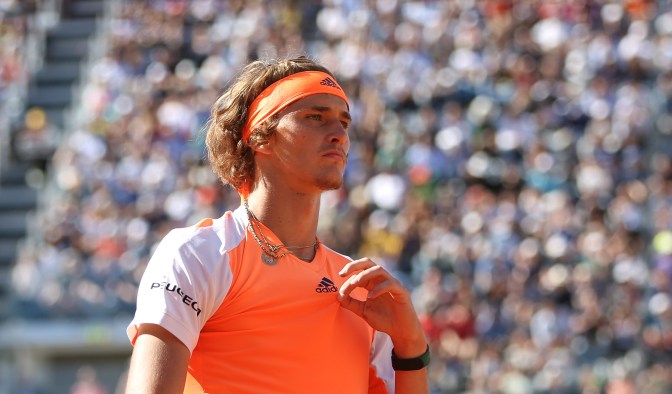
People say a lot things about Alexander Zverev to create a public perception that he’s a violent Russian-German that fights with umpires, girlfriends and his own temperament.
They rarely talk about his type 1 diabetes, an auto-immune disease which is his greatest opponent. French Open supervisors in 2023 initially didn’t even allow Zverev to inject himself on court with insulin (which he needs to stay alive) because it looked “weird”.
Like an estimated 9 million people with type 1 diabetes, Zverev often checks his blood sugar levels because his pancreas can’t produce enough insulin to move sugar from his blood into his cells. If he doesn’t manage these levels properly during a match, he can become dizzy, nervous, lethargic or hypoglycemic. He could fall into a coma and even die on the court.

Does this explain why Zverev seemed confused or agitated during the final two sets of his loss to Carlos Alcaraz at the French Open? Or was he simply an exhausted athlete reacting to line calls that went against him in the heat of battle?
Either way, Zverev is doing something unimaginable more than 100 years ago, when type 1 diabetes would kill half of all patients within 2 years, and 90 percent of them within five years, according to Harvard Medical School. Even with the invention of insulin in 1922, type 1 diabetes can still cut life expectancy by 12 years. Iconic baseball pitcher Catfish Hunter (type 1) and Jackie Robinson (type 2), the first African-American allowed to play major league baseball, both died at age 53. Baseball hall-of-famer and broadcaster Ron Santo concealed his type 1 diabetes until 1971, and often gauged his blood sugar levels on his moods. He raised millions of dollars for charities and died at age 70 about a decade after both his legs were amputated.
Hockey legend Bobby Clarke and Real Madrid captain Nacho Fernandez have also had successful careers with type 1 diabetes. Tennis legends Arthur Ashe and Billie Jean King also thrived with type 2 diabetes. But you rarely hear about this from media who otherwise glorify the achievements of Ashe and King.
Indeed, tennis as a whole has missed a golden opportunity to highlight Zverev’s attempt to inspire thousands of young diabetics who might feel discouraged to play sports. Instead, accredited tennis writers such as Ben Rothenberg have pursued a smear campaign against Zverev, based on accusations by two of his ex-girlfriends.
It’s not clear if these two women sought immediate assistance from police or medical personnel after their alleged altercations with Zverev. The public will likely never know what really happened in their relationships.
But this week, state prosecutors in Germany dropped criminal charges against Zverev. Judge Barbara Luders, who ordered Zverev to pay court costs of 200,000 euros, said that Zverev could now live without further blame. Zverev’s lawyers stated that he maintains a presumption of innocence. Zverev told media at Roland Garros that he’s innocent, and he doesn’t want to hear any more questions about the matter.
The Association of Tennis Professionals, which runs the men’s tour, said in January 2023 that their 15-month investigation found insufficient evidence to support the claims against Zverev.
But many tennis fans and media still suspect that Zverev paid his way out of trouble. Others want Zverev to be more humble, or to apologize for something that he says he never did. They often overlook what Zverev has been up against: years of unproven criminal allegations against him, and a disease that could end his life during a match. His opponents such as Alcaraz, the gifted wunderkind from Spain, don’t have to carry such baggage on court with them.
((words and images copyright Christopher Johnson Globalite Media, all rights reserved))

 Grand Slam Magazine
2 thoughts on “Zverev overcomes diabetes and assault accusations to reach French Open final”